Chapter 02
Revolutionary Journey
Between 1905 and 1908, a network of secret societies spread through the districts of Bengal. This chapter explains what they were, what they wanted, and how a schoolboy from Midnapore came to be inside one.
Organisations of the period
- Anushilan Samiti
- Founded in Calcutta at the beginning of the twentieth century, initially as a physical-culture and self-discipline society. It expanded into a district-wide network after 1905 and became the principal revolutionary organisation in Bengal.
- Jugantar
- A Bengali weekly launched in 1906 that argued openly for the overthrow of British rule. Its editors were prosecuted for sedition. The name later attached to the revolutionary grouping associated with it.
- Swadeshi movement
- The mass campaign of boycott and Indian self-production that followed the 1905 Partition of Bengal. It was the recruiting ground — in the broadest sense — for everything that followed.
- The district cells
- Midnapore, Dacca, Barisal and other district towns held semi-independent branches organised around gymnasiums, study circles and student associations.
The movement
The revolutionary environment of Bengal
The Bengal revolutionary movement did not begin as a conspiracy to kill anyone. It began as a set of societies for physical training, moral discipline and national education — the kind of organisation the colonial state had no reason to be alarmed by, and initially was not.
What changed the character of these societies was the political crisis of 1905 and the government’s handling of it. The Partition of Bengal produced a mass movement; the mass movement produced prosecutions, police action against students, and a widespread sense within the younger generation that lawful protest had been tested to destruction. From roughly 1906 onwards, a section of the Anushilan Samiti and the circle around Jugantar turned towards armed action.
Their reasoning, as it appears in the surviving writing of the period, ran roughly as follows: the colonial state governed by prestige rather than by force of numbers; a small number of dramatic acts could puncture that prestige and demonstrate that British officials were not beyond reach; and the demonstration itself would awaken a population they believed to be politically passive.
It is worth stating plainly that this reasoning was contested at the time, including by many nationalists, and that the results did not match the expectation. The immediate consequence of the Bengal revolutionary campaign was a severe expansion of colonial policing powers, the Alipore conspiracy prosecutions, and the deaths of a number of people who had no part in the political dispute at all.
His involvement
How Khudiram Bose entered the movement
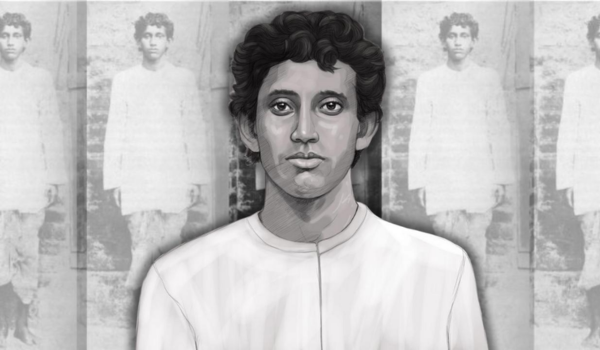
The documented outline is short. He was recruited into the revolutionary circles of Midnapore while still at school, in or around 1905–1906. Accounts of the period credit Hemchandra Kanungo — himself a significant figure in the Bengal movement, who later travelled to Europe to study bomb-making — with drawing him in. Visits to Midnapore by Sri Aurobindo and by Sister Nivedita are recorded as having made a strong impression on the town’s student circles in these years.
In 1906 he was arrested at Midnapore for distributing copies of the nationalist pamphlet Sonar Bangla. He was defended by the barrister Birendranath Sasmal and released. He was sixteen years old, and this is the first appearance of his name in an official record.
Between that arrest and April 1908 the documentary trail is thin. What is certain is that by the spring of 1908 he had been selected, along with Prafulla Chaki, for the operation against Douglas Kingsford in Muzaffarpur — which means that within roughly two years he had moved from pamphlet distribution to the most serious work the organisation undertook.
Why the societies recruited students
The movement was built out of schoolboys, and that was deliberate
- Existing structures
- Gymnasiums, akharas and study circles already gathered young men regularly and without suspicion. The societies grew inside structures that were already there.
- Mobility
- Students could travel between districts for examinations, family visits and school business without attracting official attention.
- Fewer dependants
- Unmarried boys without households were, in the calculation of the organisers, able to accept risks that older members with families could not.
- Political formation
- The Swadeshi years had politicised the schools directly. Boycott campaigns were run by students; disciplinary action against them radicalised them further.
- The consequence
- Those who paid the heaviest price were, overwhelmingly, teenagers. Khudiram Bose was eighteen at his death; Prafulla Chaki about nineteen.
The state
Surveillance, prosecution and the colonial response
The government of Bengal responded to the Swadeshi agitation and to the emergence of the secret societies with an expanding apparatus of control: prosecutions of nationalist editors for sedition, restrictions on public meetings and processions, disciplinary measures against students who took part in boycott activity, and a substantial growth in political intelligence work.
Among the officials most closely identified with this response in nationalist opinion was Douglas Kingsford, Chief Presidency Magistrate of Calcutta. Kingsford passed severe sentences on young political workers and on the editors of nationalist papers, including Jugantar. He became particularly resented after ordering the whipping of a young man, Sushil Sen, who had taken part in protests connected with the Jugantar prosecution. Corporal punishment of a boy from a respectable family, ordered by a British magistrate, was received in Bengal as a public humiliation rather than a routine sentence.
Kingsford was subsequently transferred out of Calcutta to Muzaffarpur, in Bihar, as District and Sessions Judge. Whether the transfer was intended to remove him from danger or was ordinary administrative rotation is a matter on which accounts differ. What is not in dispute is that the revolutionary group in Calcutta continued to regard him as a target after the move.
An earlier attempt on his life had already failed. In March 1908, a parcel containing a concealed explosive device was sent to him in the form of a book. It was never opened. The Muzaffarpur operation followed.